
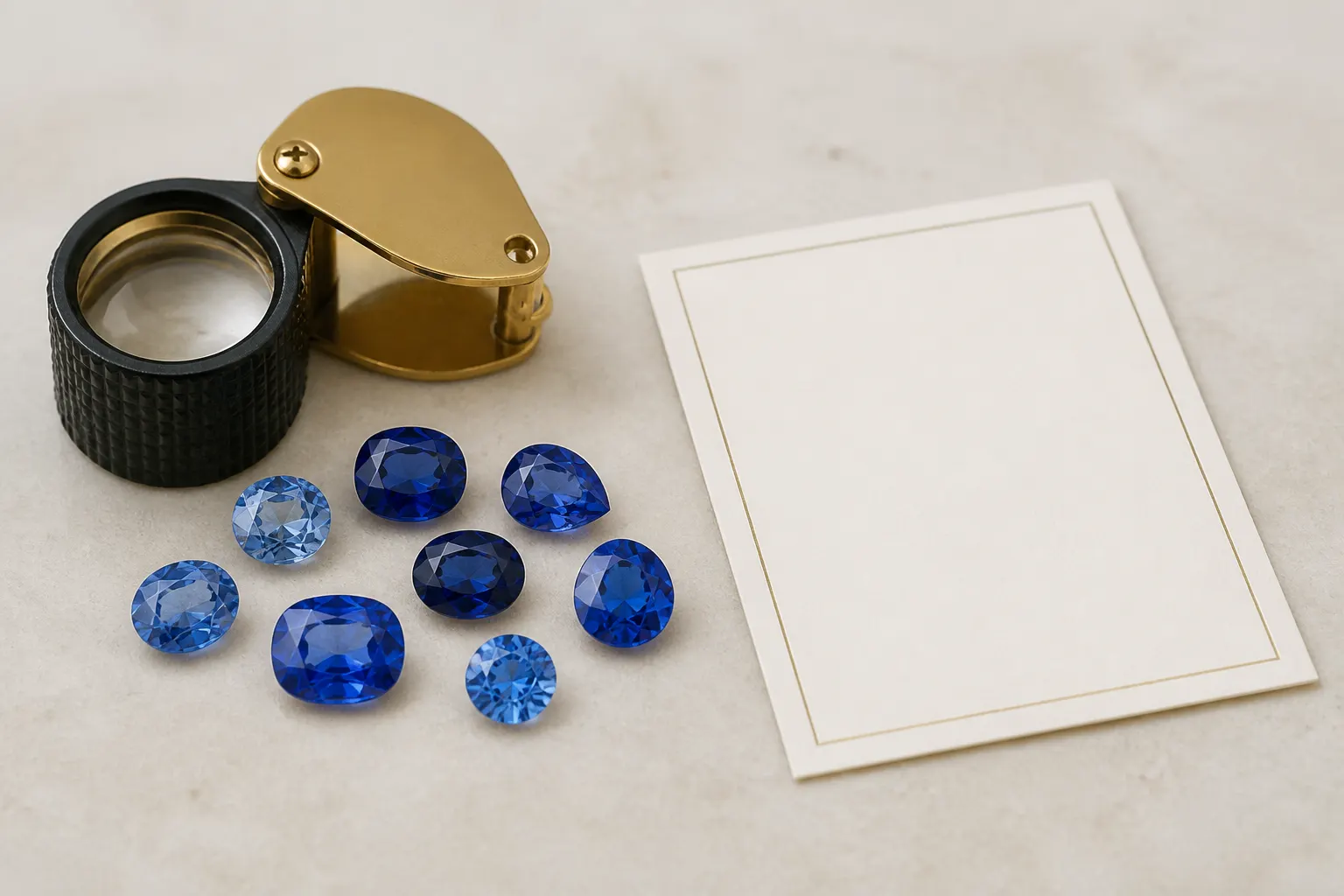
Start with color, then look at the whole stone
For blue sapphire, color often drives preference and price. Look for a hue you enjoy, even saturation, and a stone that is neither distractingly dark nor washed out in the lighting where you will wear it.
| Factor | What to look for |
|---|---|
| Color | A blue you love with good saturation |
| Cut | Even sparkle and no large dull “window” |
| Clarity | Inclusions that do not weaken or distract |
| Carat | Weight, not face-up size; compare dimensions |
Ask about treatment
Heat treatment is common in sapphire and can improve color and clarity. The key issue is disclosure. Other treatments may affect value or care requirements more significantly. For a valuable stone, request a report from a respected independent gemological laboratory.
Natural or lab-created?
Lab-created sapphire has essentially the same chemical composition and hardness as natural sapphire, but it is made in a controlled environment. It usually costs less. Choose based on your priorities, and insist that the seller clearly discloses origin.
Five questions to ask a seller
- Is this sapphire natural or lab-created?
- What treatments has it received?
- Is there an independent laboratory report?
- What is the return and resize policy?
- Does the setting come with a warranty or inspection plan?
Compare the stone in different light, read the complete return terms, and keep receipts and reports. Avoid sellers who promise investment returns or medical benefits.
Protect what you buy
Read the care guideHow to compare two sapphires fairly
Compare loose stones or finished pieces under the same lighting, against the same neutral background, and from similar viewing distances. Record dimensions as well as carat weight: two stones of equal weight can face up at noticeably different sizes. Look for even light return, distracting dark zones, a transparent window through the center, and inclusions that reach the surface.
Online buying safeguards
- Request an unedited video in daylight and ordinary indoor light.
- Confirm that photographs show the exact stone, not a representative sample.
- Save the treatment disclosure, dimensions, return terms, and seller invoice.
- Use a payment method with appropriate purchase protection.
- For a high-value stone, make the sale conditional on independent verification.
Red flags worth pausing for
Be cautious with vague phrases such as “investment grade,” guaranteed appreciation, undisclosed “enhancement,” or country-of-origin claims without suitable evidence. A laboratory report identifies characteristics and detectable treatments; it is not automatically an appraisal, warranty, or prediction of future value.
Sources and review notes
- GIA Sapphire Buyer Guide — quality factors, treatments, and reports.
- GIA Sapphire Care and Cleaning — hardness, durability, and treatment-sensitive care.
Astrological associations are presented as tradition, not scientific fact. Commercial claims and prices are intentionally excluded.